
Lubricants for food and beverage processing
Food plants combine everything that’s hard on a lubricant: washdowns, heat from ovens and fryers, cold from freezers, heavy conveyor use and the constant risk of contamination. We match every machine to an NSF H1 lubricant that lasts, and help you keep the audit clean.
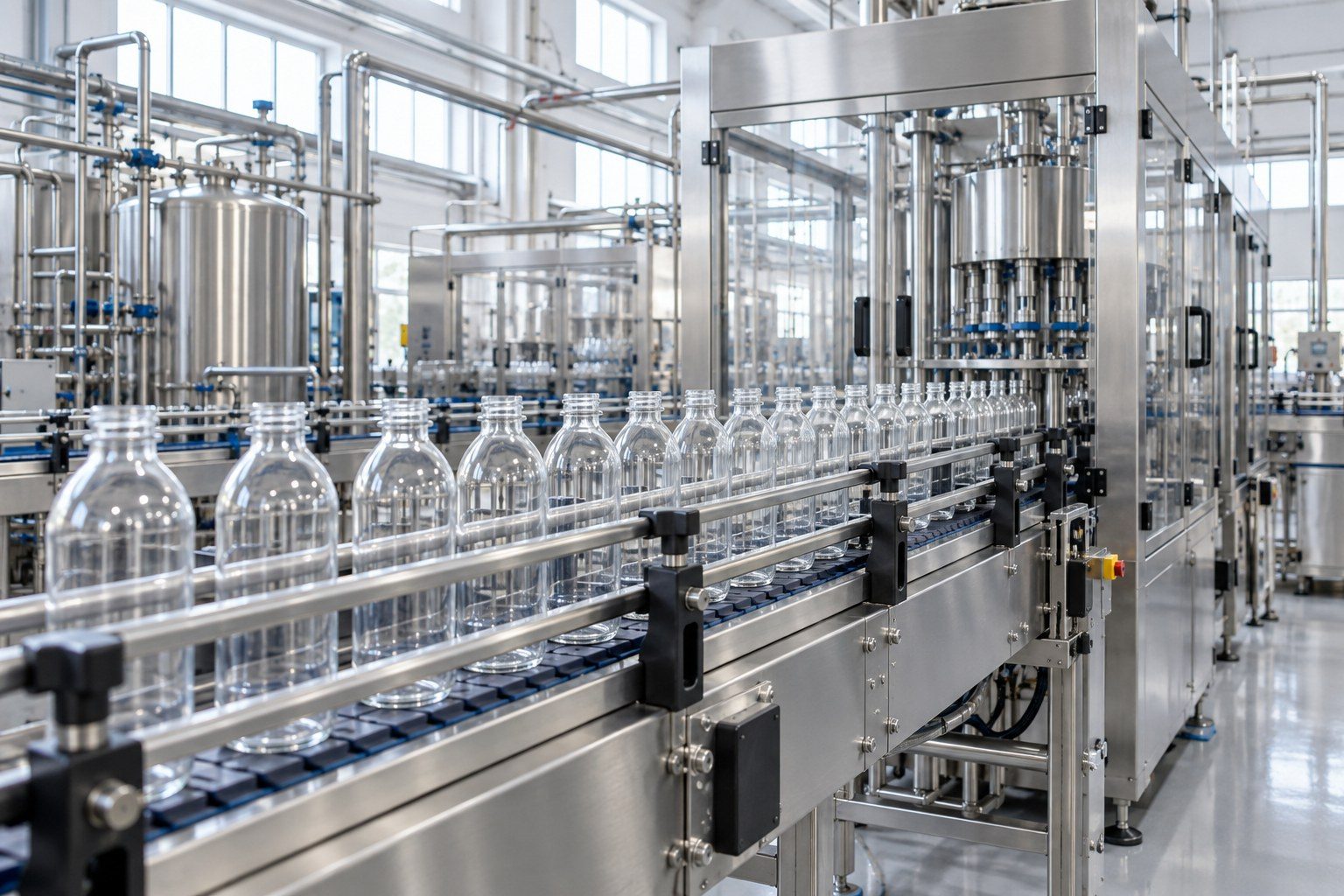
Why food plants are hard on lubricants
A lubricant that washes out or carbonizes means more downtime. One that isn’t food-grade becomes an audit problem.
Pick your equipment
Choose a machine to see the food-grade products we recommend. Not sure? Send us the equipment list and we’ll match each point.
Conveyors & chains
Common problems, and what fixes them
Every product below is NSF H1 registered or made for food-plant use.
| Equipment | Common problem | What we recommend |
|---|---|---|
| Conveyor chains & slides | Oil flung onto product, gumming, wear | Lubriplate FMO-AW oils, SFGO Ultra, FMO-350-AW Aerosol |
| Oven chains (bakery, drying) | Heat carbonizes oil into deposits | Lubriplate HTCL-FG · Kem-A-Trix KCL 220 |
| Hot oven bearings | Grease bakes off; frequent regreasing | Lubriplate Synxtreme FG /220 grades · Krytox™ GPL 206 |
| Freezers & cold rooms | Grease stiffens; bearings starve at start-up | Lubriplate SFL series (from −51 °C) |
| Washdown bearings | Water and caustic wash grease out | Lubriplate FGL-1/FGL-2, Synxtreme FG · Kem-A-Trix KG Series |
| Sealed bearings | Short life in wet areas | Kem-A-Trix SBG sealed-bearing gel |
| Gearboxes (mixers, fillers, conveyors) | Heat, wear, short oil life | Lubriplate SFGO Ultra, PGO-FGL |
| Hydraulic systems | Leaks near product, wear | Lubriplate FMO-AW (orange option for leak detection) |
| Air compressors | High discharge temperatures | Lubriplate Syncool FG, SFGO Ultra · Kem-A-Trix Pro-Last FGX |
| Can seamers | High speed, centralized lube | Lubriplate FGL-CC · Lincoln automatic systems |
| Packaging machinery | Heat and long service intervals | Krytox™ GPL 205, GPL 206, GPL 225 |
| Pumps, valves & agitators | Leaks at the packing | Kem-A-Trix IFS 5400 injectable sealant |
| Changeover to H1 | Old H2 oil left in the system | Lubriplate Pure Flush |
Temperatures from Lubriplate’s H1 product catalogue. We’ll confirm the right grade and viscosity for each machine.
What the food-grade ratings mean
NSF registers lubricants by how close they can be to food.
Using H1 lubricants throughout the plant can remove lubrication as a critical control point in your HACCP plan. Lubriplate and Kem-A-Trix food-grade products are made under NSF/ISO 21469 certified quality systems.
A changeover plan, not just a product list
We walk the plant, list every lube point, and match each one to an H1 product, with a cross-reference from what you use now.
Before switching, systems are flushed with Lubriplate Pure Flush so old H2 oil doesn’t stay behind. We can then set up a colour-coded lubrication program with charts and machinery tags, so the right product goes in the right place every time.
What we supply
Food-grade lubrication FAQ
What does NSF H1 mean?
H1 lubricants are registered for incidental food contact: they can be used where a small amount might touch food or packaging. They are made from ingredients listed in FDA 21 CFR 178.3570.
Do H1 lubricants perform as well as standard ones?
For most food-plant machinery, yes. Today’s synthetic H1 greases and oils cover wide temperature ranges and extreme-pressure duty. We’ll match the performance of what you use now.
Should we use H1 everywhere?
Many plants standardize on H1 for every machine in the food zone. It simplifies HACCP, avoids mix-ups and means fewer products on the shelf.
Are your food-grade products Kosher and Halal?
Kem-A-Trix food-grade products carry Kosher and Halal approvals. Ask us for the certificate for any other product.
How do we switch from H2 to H1?
Flush the system to remove the old oil, refill with the H1 product, and label the lube point. We plan the order of the changeover with your maintenance team.
Tell us about your plant. We'll match every machine to an H1 lubricant.
Send the equipment and what you use today, or book a walk-through. We reply within one business day, in English or French.